consulting
Confidential CFO tooling
A private funding cockpit for a nonprofit's CFO: next year's gap, and who could close it.
the problem
An operating nonprofit in child education has to raise the money for its operating budget from scratch every year. It runs programmes with fixed staff costs, and the money arrives mostly as restricted, time-limited grants from many kinds of funder.
why it hurts
The CFO cannot sign off next year's hiring plan without knowing the gap, and the answers (what is covered, which grants end with nothing lined up, how much rests on a few funders) sat in four different heads and spreadsheets.
what i built
A funding coverage cockpit built around the CFO, the person who owns the funding risk: coverage by year and cluster, a radar for grants ending with nothing lined up, a concentration view, and a matched prospect on every gap. Kept private at the client's request.
Figures in the video are illustrative.
how it works
Built for the CFO first.
whyThe CFO's problem is forward funding against fixed, non-negotiable salary costs, and none of the answers sat in one place.
Point at how to fill each gap.
whyA gap with a matched prospect and a way in is something the CFO can act on.
Include the government partnership layer.
whyUnder that model the government is landlord, regulator and funder at once.
in detail
The Coverage cockpit: the numbers a CFO needs before signing off next year's hiring plan.
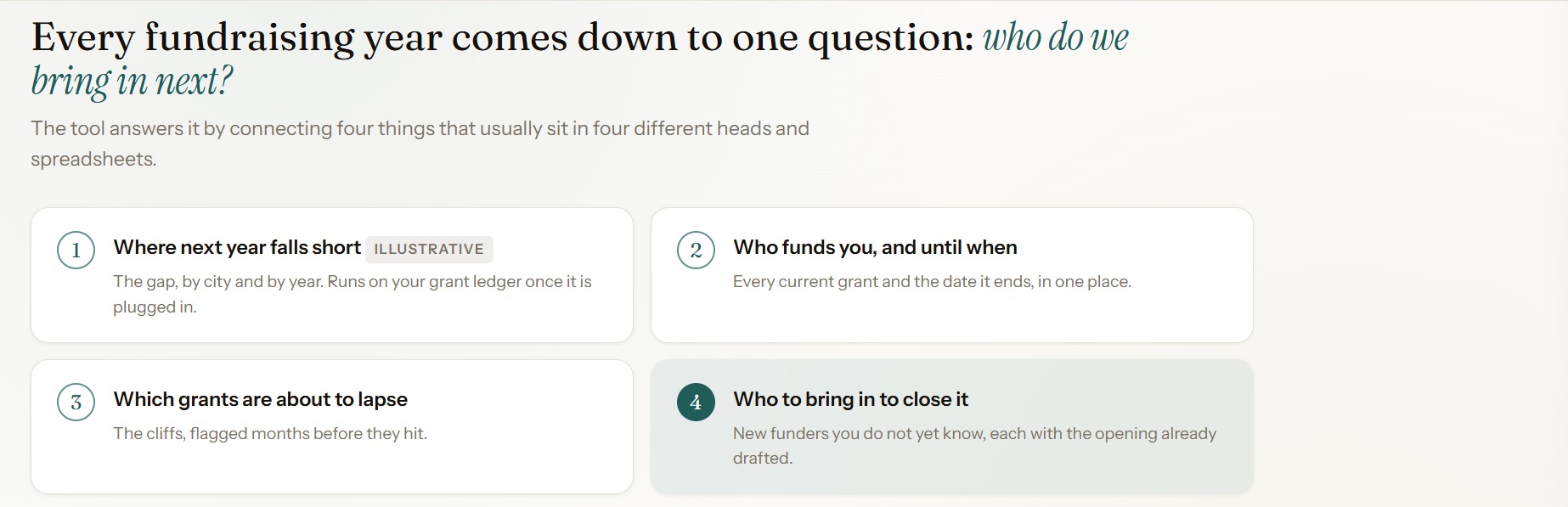
What it answers
Where next year falls short, who funds the organisation and until when, which grants are about to lapse (the cliffs, flagged months before they hit, with no replacement identified), and who to bring in to close the gap. Alongside them, concentration: how much of the funding base rests on a handful of funders.
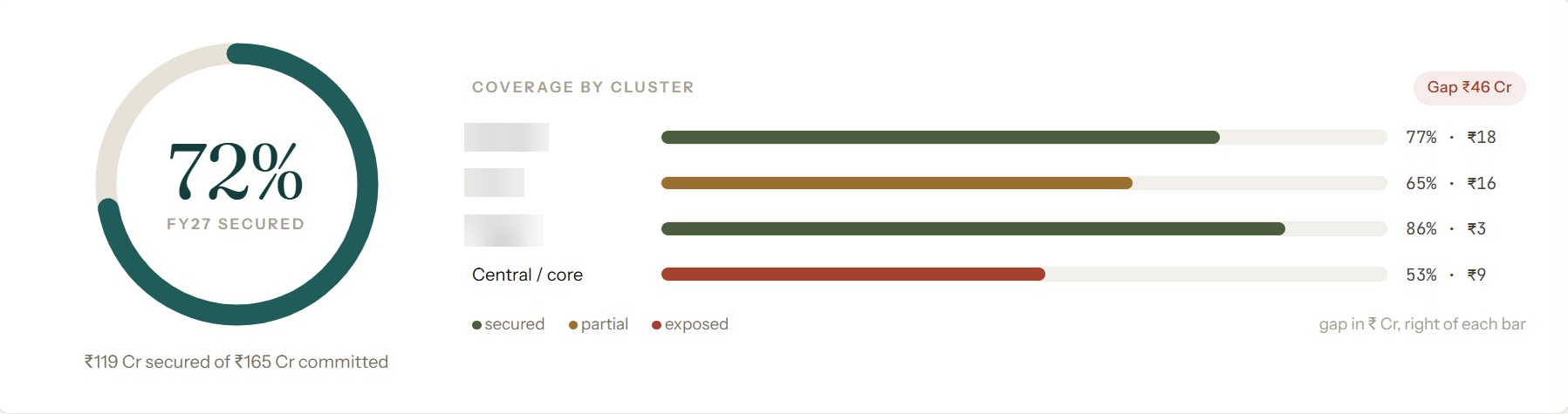
Coverage view
Forward funding coverage by year and by cluster, with the gap on each.
Most cluster names, and every amount, withheld.
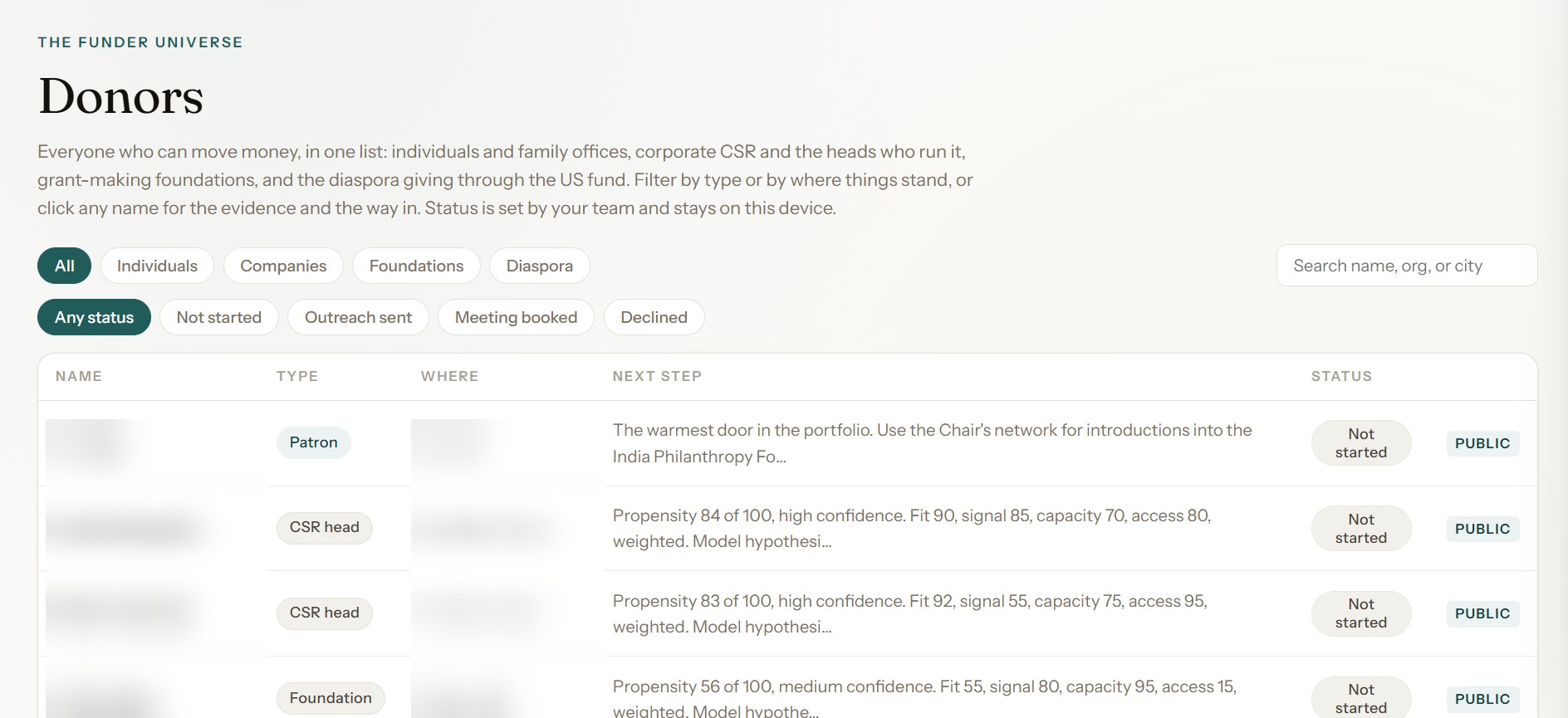
Matched prospects on every gap
Every gap links to a matched, well-timed prospect with a credible way in.
Names, locations and funder details withheld.
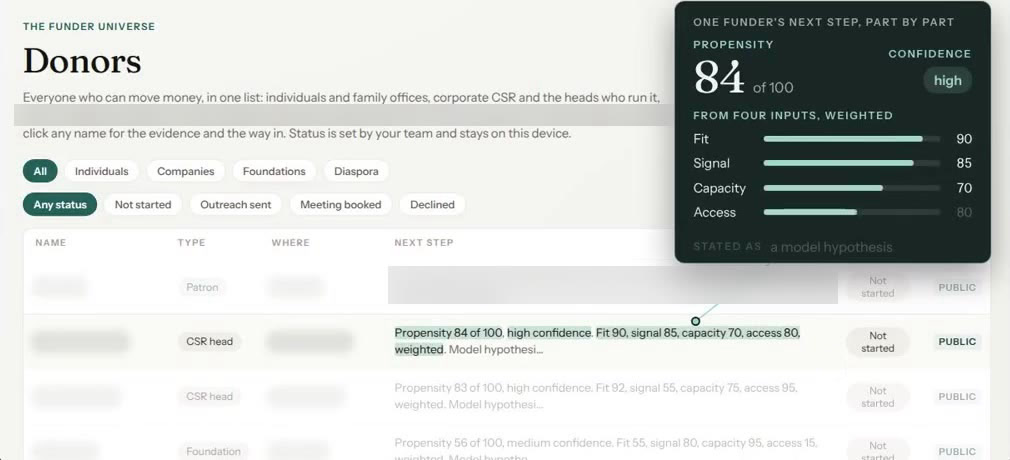
Scored, with reasons
Each prospect carries a propensity out of 100 from fit, signal, capacity and access, weighted, with its confidence stated and labelled a model hypothesis.
Names withheld.
No fabricated funding signal is ever attached to a real, named person. The working cockpit stays private, since it carries the real ledger; what is shown here is the redacted build.
why it's useful
The CFO sees next year's gap before committing to salaries, and every gap points to a well-timed prospect with a credible way in. Pitched to the CFO, then built and demoed.
outcomes
- Est. to save the team 170 hours of manual work a year and bring in ₹1 Cr in incremental funding.
Pitched to the CFO, then built and demoed. It answers three questions in one place:
- How much of next year's fixed salary cost is already secured.
- Which multi-year grants roll off with nothing behind them.
- How concentrated the funding base has become.
technical specs
- Forward funding coverage by year and by cluster: how much of next year's fixed salary cost is already secured, with the gap on each cluster.
- A cliff radar: multi-year grants ending soon with nothing identified behind them, flagged months before they hit.
- Concentration: how much of the funding base rests on a handful of funders.
- A funder universe, filterable by type and by where each relationship stands, with the way in already drafted.
- Each prospect is scored out of 100 from four weighted inputs (fit, signal, capacity and access), with its confidence stated and labelled a model hypothesis.
- A government partnership layer, since under the organisation's model the government is landlord, regulator and funder at once.
- No funding signal is ever attached to a real, named person.