build
Connote
The app that argues back.
Three AI stories a day, your call on each, and the best cited case against it.
at a glance
- What it is
- A daily AI news game: three AI stories a day, sixty words each from the source; you call each one yes or no and say how sure you are, then Kit the fox brings the best cited case against you.
- My role
- Designed and built it, the challenge engine underneath and the game on top.
- What I built
- An engine that searches for dated evidence against a view and quotes it word for word, and on it the daily game: the three stories, the call, Kit's pushback with its receipts, your move (concede, refine or hold), and a ledger that scores each call when the world answers.
- Result
- Switched on for one player, its maker, behind a hard monthly spending cap. Not open to anyone else yet.
what i made
One real morning: the 28 September edition and Kit's real pushback, replayed in film mode.
context
AI reading tools summarise, retrieve and agree. Connote is built for the opposite job: you say what you think, and the AI goes to find out whether you are wrong, with evidence it has to cite. The daily game puts that behind a five-minute habit on the day's AI news.
thinking
No evidence, no argument.
whyIf no two dated sources from two different sites argue against the call, Kit says so and shows where it looked, rather than inventing a counter.
Every receipt is quoted word for word, and code checks it.
whyThe model must quote the sentence from its source that most undermines the call; code checks the quote is really there, and a source without a date cannot be cited.
Score calls with a rule that cannot be gamed.
whyThe first points formula paid more for claiming more certainty than you had. The game uses one that pays most for saying what you actually believe, and a test checks it across the whole 55 to 95 scale.
in detail
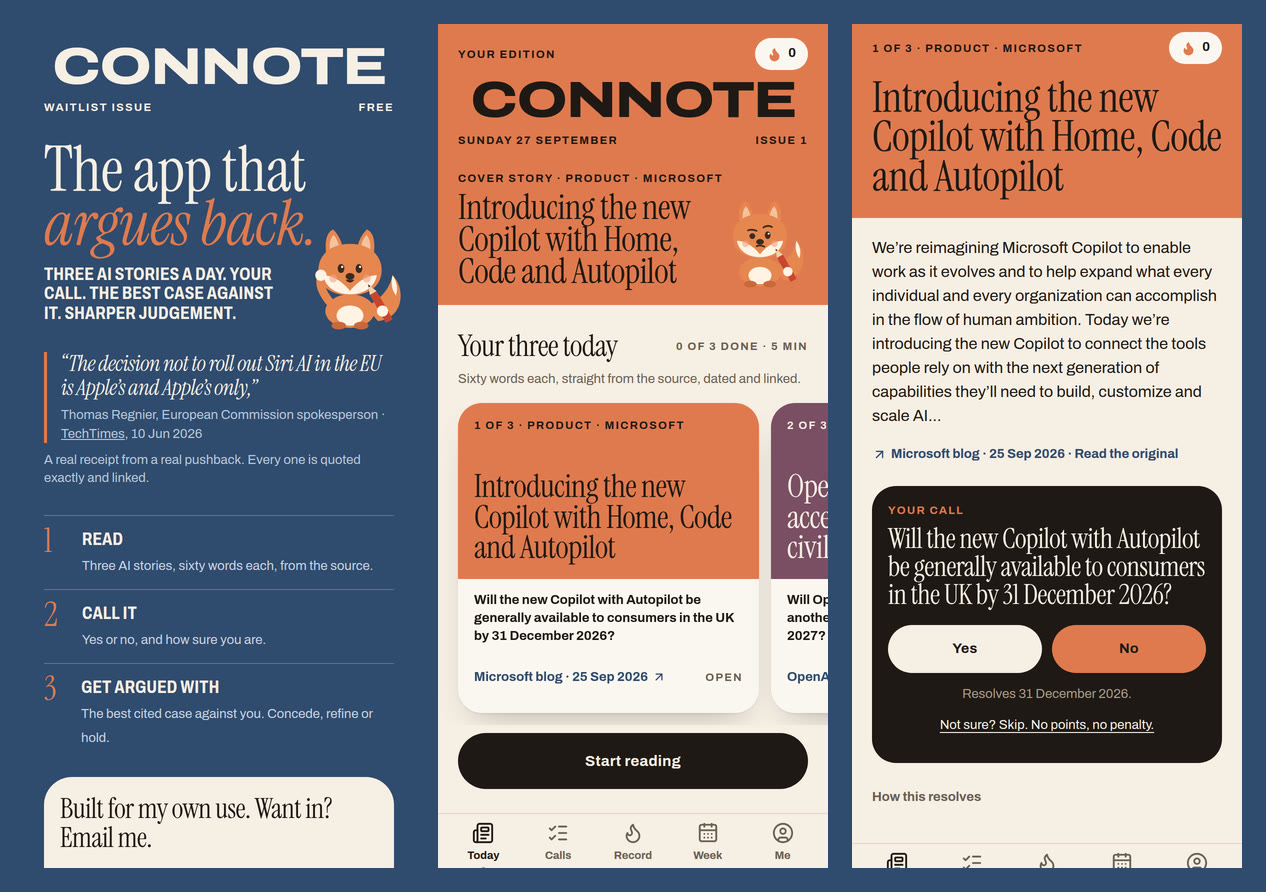
01 / 03
The cover, the day's three and one story, sixty words from the source with its publisher and date. The edition of 27 September, real stories.
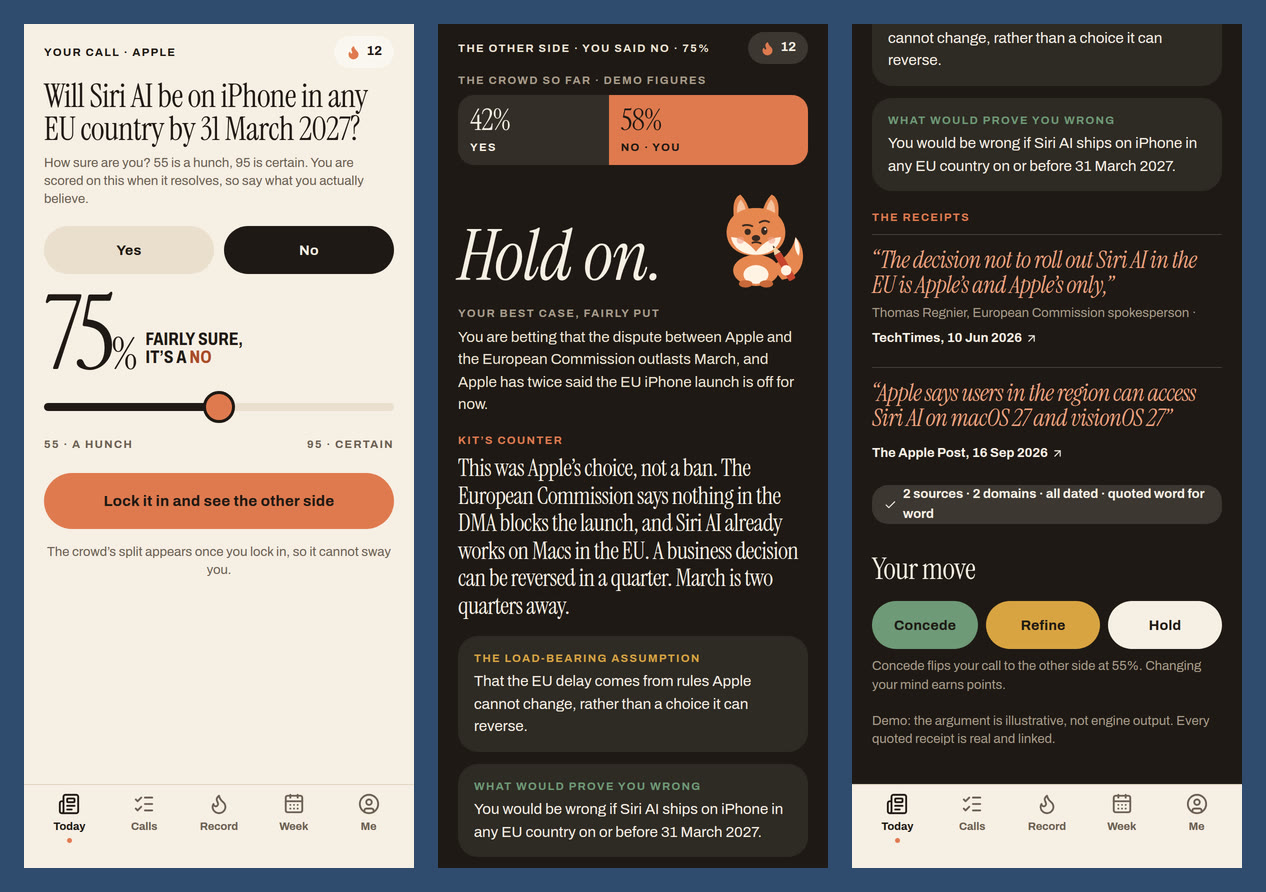
02 / 03
Make your call, then Kit's pushback: your best case fairly put, the counter, the load-bearing assumption, what would prove you wrong, and the receipts. From the demo edition: the argument is illustrative, as the screen says; the receipts are real and linked.
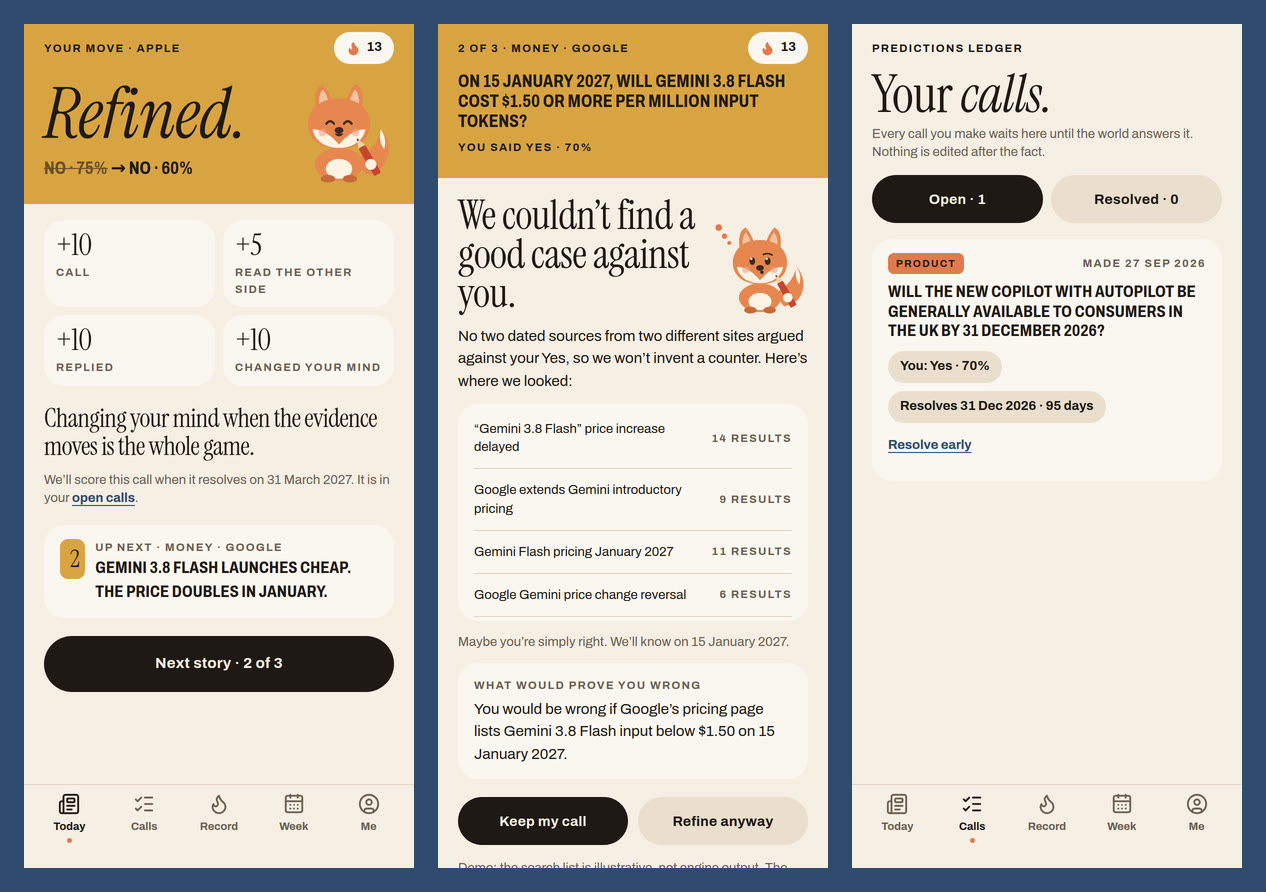
03 / 03
Your move, an honest "we couldn't find a good case against you" with where Kit looked, and the ledger where every call waits until the world answers it. The first two from the demo edition, the ledger from the real one.
technical specs
- Every screen reads and writes through one repository interface, so the game ran first on a demo data layer and moved to the real database without a screen changing.
- Every model call is logged with its cost. The server refuses a third pushback in a day, or anything past the monthly cap, before it spends.
- Under the game is the original notebook: capture a take, and the engine extracts its claims, searches for evidence against them and writes a cited challenge only if it finds some.